
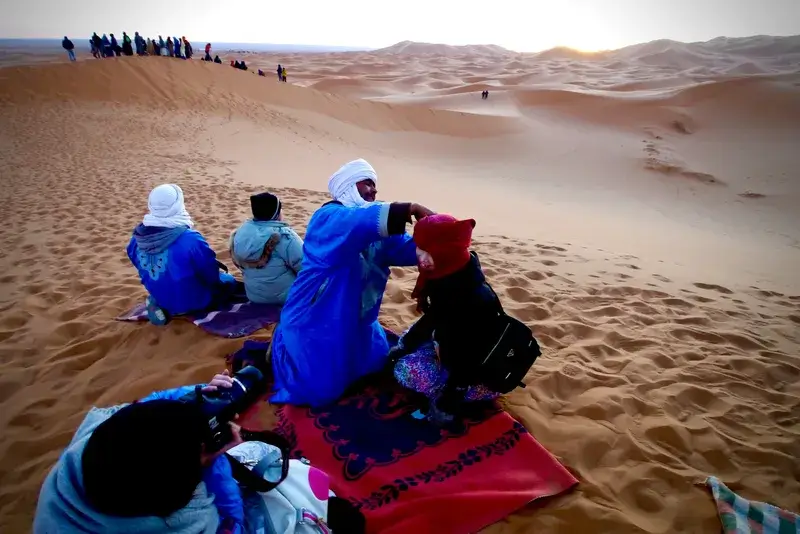
Short answer: the best time to visit the Sahara desert in Morocco is October to April. Days in Merzouga are warm and sunny, between about 19°C and 30°C, and evenings around the campfire are cool and pleasant. The very best months are March, April, October and November.
Summer (June to August) is the hardest time: afternoons reach 40–45°C. Winter (December to February) has lovely mild days, but nights in the dunes can drop close to freezing, so you’ll want warm layers.
We take travelers to Merzouga all year round, so this guide is based on what our guests actually experience, month after month: the weather, the crowds, and what to pack.
These are typical averages for Merzouga and the Erg Chebbi dunes. Real days can be a few degrees warmer or colder. On mobile, swipe the table sideways to see every column.
| Month | Day (°C) | Night (°C) | Crowds | Our verdict |
|---|---|---|---|---|
| January | 19 | 4–6 | Low | Good: sunny days, cold nights |
| February | 21 | 5–6 | Low to medium | Good: warming up, few visitors |
| March | 25 | 9 | High | Excellent |
| April | 29–30 | 13–15 | High | Excellent |
| May | 33–34 | 20 | Medium | Good, getting hot |
| June | 39 | 25 | Low | Hot: sunrise and sunset only |
| July | 43 | 29 | Low | Very hot |
| August | 42 | 28 | Medium | Very hot |
| September | 34–35 | 22–24 | Medium | Good from mid-month |
| October | 30 | 14 | High | Excellent |
| November | 23–24 | 7–9 | High | Excellent |
| December | 19–20 | 4–7 | Medium, busy at Christmas | Good: mild days, cold nights |
Rain is rare in every month, with usually only 1 or 2 rainy days. Climate data: Weather & Climate.
Spring brings warm days of 25–30°C, comfortable nights, and green palm groves in the valleys on the way south. It’s ideal for camel treks at any time of day. It’s also the busiest season, especially around Easter, so book your desert camp early. Spring can be windy, and the odd sandstorm blows through, usually lasting only a few hours.
Afternoons reach 40–45°C, and nights stay warm at 25–29°C. You can still enjoy the desert in summer: ride the camels at sunset, sleep under the stars, and watch sunrise from the dunes before the heat arrives. Spend the middle of the day resting in the shade. Camps are quieter and prices are often lower.
After the summer heat, autumn brings warm, golden days and cool, clear nights. October and November are as good as spring, with stable weather, soft light for photos and fewer strong winds. Early September can still be very hot.
Winter days are mild and sunny at around 19–21°C, perfect for walking the dunes. Once the sun goes down, the temperature drops fast, often to 3–6°C and sometimes close to freezing. Luxury camps provide thick blankets, and winter nights give you the clearest starry skies of the year. Snow can briefly close the Tizi n’Tichka pass over the High Atlas. When that happens, your driver will take another road or adjust the schedule.
Holidays and crowds. Christmas and New Year, Easter and the European school holidays in February and April are the busiest weeks in the desert. Camps fill up early, so book 2–3 months ahead if you’re traveling then.
Ramadan. In 2027, Ramadan is expected to run from about 8 February to 9 March, depending on the moon sighting in Morocco. Tours run as usual, and it’s an interesting time to see Moroccan culture. Some restaurants close during the day, and everything gets lively after sunset.
Stargazing. The Sahara has some of the darkest skies you’ll ever see. For the most stars and the Milky Way, travel close to the new moon. Around the full moon, the dunes glow silver, which is beautiful in a different way.
Wind and sandstorms. Strong winds are most common in spring. A sandstorm rarely lasts more than a few hours, and camps are built to handle them. Bring a scarf (a local cheche) to cover your face.
| Season | Must-haves |
|---|---|
| Spring and autumn | Light layers, a fleece or light jacket for the evening, sunglasses, sunscreen, a scarf for wind |
| Summer | Loose, light-colored cotton clothes, a wide-brimmed hat, high-SPF sunscreen, a refillable water bottle |
| Winter | A warm down jacket, a hat and gloves for the night, thermal layers, warm socks for the camp |
All year round, bring closed shoes or sandals for the sand, a small flashlight and a power bank. For the full list, see our Sahara desert packing checklist.
March, April, October and November. They have warm days, comfortable nights and stable weather.
It’s hot, with afternoons of 40–45°C, but still doable. Do the camel trek at sunset, watch sunrise from the dunes, and rest in the shade at midday.
In December and January, nights in Merzouga usually drop to 3–6°C and sometimes close to freezing. Camps provide thick blankets, but bring a warm jacket.
Very rarely. Most months have only 1 or 2 rainy days, and showers are short.
Yes. Tours and desert camps run as usual. Some restaurants close during the day, and evenings are lively after the fast is broken.
For Christmas, New Year, Easter and spring, book 2–3 months ahead. At other times, a few weeks is usually enough.
Whatever month you choose, the dunes of Erg Chebbi are unforgettable. Our private desert tours run all year, with a dedicated English-speaking driver, a night in a luxury Amazigh camp and a camel trek timed to the best light and temperature of the season.
Not sure which dates suit you best? Message us on WhatsApp with your travel month, and we’ll tell you honestly what to expect.
Read next: What to Pack for a Sahara Desert Tour · Is Morocco Safe for Tourists? · Tipping in Morocco
About the author
Miloud, tour guide at Proper Morocco Tours
Miloud was born in Merzouga and has spent many years guiding travelers across Morocco, from the medinas of Marrakech and Fes to the dunes of Merzouga. He writes our guides so you arrive knowing what locals know.